
You're probably here for one of two reasons. Either you saw an online offer for “high quality” fake bills and want to know if it's real, or you need realistic cash for a film shoot, music video, theater production, training exercise, or classroom demonstration.
Those are not the same thing.
One path leads straight into fraud, seizure, criminal exposure, and a very bad conversation with law enforcement. The other leads to legal prop currency that's designed for cameras, not cash registers. If you want to buy fake currency online, you need to know the operational difference before you click, pay, or even start a conversation with a seller.
Table of Contents
- The Hidden Dangers of Buying Fake Currency Online
- Counterfeit vs Prop Money A Critical Distinction
- The High Price of Counterfeiting Legal Consequences
- How to Source Legal Prop Money for Creative Projects
- Vetting Online Vendors A Safety Checklist
- The Smart Choice Making a Safe and Legal Decision
The Hidden Dangers of Buying Fake Currency Online
The internet makes bad decisions look normal. A polished product page, a Telegram handle, a few staged photos, and suddenly an obvious felony is packaged like a routine online purchase.
That's the trap.
People search “buy fake currency online” for mixed reasons, but criminal sellers don't care why you arrived. They care whether you'll send money, move to private chat, and stop asking questions. Once you do that, you've already entered a risky chain of conduct that can expose you to fraud, blackmail, non-delivery scams, or far worse if the product is intended to pass as real.
Practical rule: If a seller talks about realism in terms of “passing,” “washing,” “undetectable quality,” or “usable in stores,” you're no longer looking at props. You're looking at criminal intent.
The danger isn't just legal. It's operational. Illicit sellers hide identities, shift communication off-platform, and avoid transparent checkout for a reason. They don't run normal customer service because they aren't running a normal business.
Here's the plain reality:
- If the item is meant to deceive, it's counterfeit.
- If the seller wants secrecy, that's a warning, not a feature.
- If the listing blurs legality, assume the risk lands on you.
A legitimate buyer has a clean alternative. Film crews, theater departments, photographers, trainers, and educators can use prop currency that is clearly marked and obviously not intended to circulate as legal tender. That's the safe lane. Stay in it.
What to do before you buy anything
Use this quick decision filter before you contact any seller:
- Define the use case. Is this for on-camera work, stage blocking, retail training, classroom instruction, or a novelty display?
- Check the product language. Legal products describe themselves as props, novelty bills, or motion picture money.
- Reject secrecy. If the first step is encrypted messaging with no normal checkout, leave.
- Assume screenshots prove nothing. Photos can be staged, edited, or stolen.
- Protect your project. If you need realism, get compliance first and camera realism second.
That's how professionals think. They don't ask, “Can I get away with this?” They ask, “Will this survive scrutiny on set, in transit, and if a police officer sees it?”
Counterfeit vs Prop Money A Critical Distinction
A toy sword and a sharpened blade can look similar from a distance. Up close, one is designed for performance and the other is designed to wound. Counterfeit and prop money work the same way. The resemblance is not the point. Intent and design are the point.
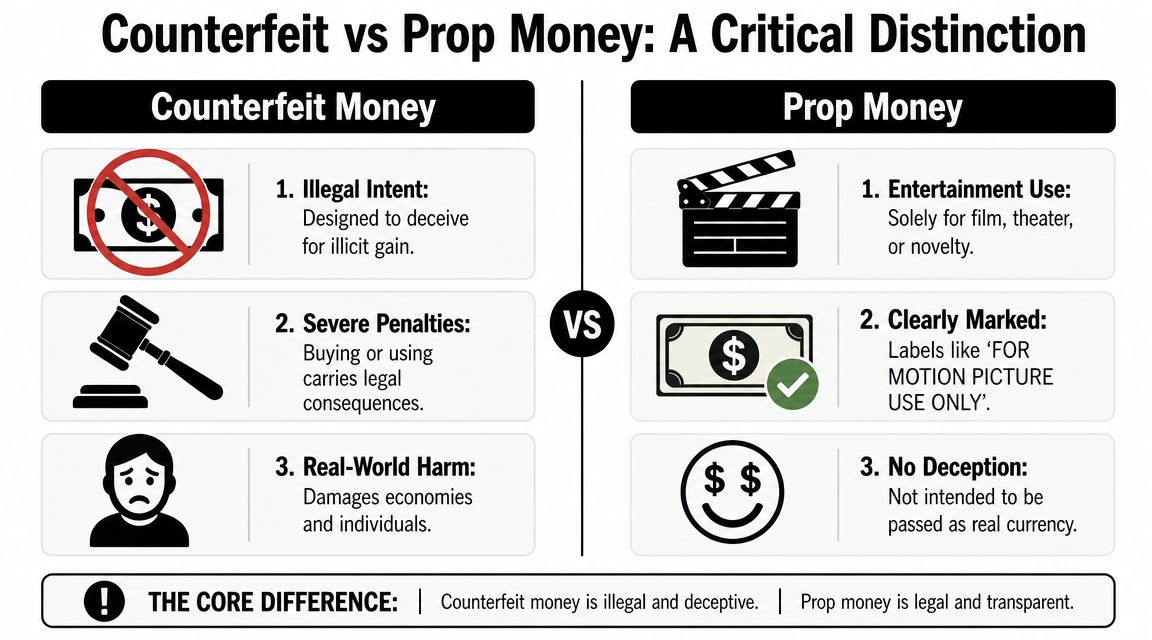
Counterfeit currency is made to fool a cashier, a customer, a machine, or a victim. Prop money is made to look convincing on camera or from stage distance while still signaling that it is not genuine legal tender. If that distinction isn't obvious from the product itself, you shouldn't touch it.
What counterfeiters try to copy
Real U.S. notes aren't authenticated by one trick. They're checked through multiple security layers at once, including microprinting, raised intaglio texture, watermark, security thread, and color-shifting ink. The $100 note also uses a 3-D security ribbon. That multi-layer approach is why strong verification catches many fakes and why reproducing a note convincingly is difficult, as outlined in Prevail Bank's explanation of counterfeit detection features.
A criminal counterfeit tries to imitate those signals closely enough to survive a hurried glance or a weak inspection. That's why language like “looks and feels real” is dangerous when it appears without legal disclaimers.
| Feature | Counterfeit currency | Legal prop money |
|---|---|---|
| Purpose | Deception | Performance, display, training |
| Design goal | Pass as real | Read as fake under inspection |
| Seller language | Secretive, coded, evasive | Open, compliant, plainly labeled |
| Risk | Criminal exposure | Managed professional use |
| Typical audience | Fraudsters and scammers | Producers, schools, photographers |
What legal prop money does differently
Legal prop currency should look like a tool, not a trap. It should be clearly marked, often with language such as “FOR MOTION PICTURE USE ONLY” or similar disclosure. Many compliant products also use obvious visual differences that reduce the chance of confusion during handling, transport, or cleanup after a shoot.
When you review legal prop money options, don't get distracted by cinematic realism alone. Focus on whether the seller treats legality as a visible product feature. Serious suppliers don't bury that. They lead with it.
If a seller markets “movie money” but avoids showing labels, disclosures, or product limitations, treat that as a refusal to answer the only question that matters.
A prop supplier wants you to use the bills safely on set. A counterfeiter wants the bills to survive contact with the public. That single difference changes everything.
The High Price of Counterfeiting Legal Consequences
Buying counterfeit currency isn't edgy. It's reckless. You're stepping into fraud territory, and once intent, possession, distribution, or passing enters the picture, the consequences can follow you for years.
A lot of people make the same bad assumption: if counterfeit notes are relatively rare, enforcement must be casual. It isn't. The Federal Reserve paper on counterfeit currency notes that an estimate puts counterfeit U.S. currency in circulation at about $15 million, with an upper bound of about $30 million, or roughly 1 counterfeit note in 40,000, with a more likely domestic level of fewer than 1 in 80,000 notes. That same paper also states that the U.S. Secret Service recorded $102 million in counterfeit currency passed on the public worldwide in fiscal year 2023. Read the figures in the Federal Reserve analysis of counterfeit currency in circulation.
Why enforcement stays active
Counterfeiting stays on law enforcement radar because every fake note affects a real person. A retailer takes the loss. A worker gets blamed for accepting it. A business owner tightens cash handling. Investigators follow the paper trail, digital trail, shipping trail, and communication trail.
You also don't need to be a mastermind to get charged. Buying, storing, forwarding, or trying to pass notes can pull you into a case. “I only ordered them” is not the defense people think it is.
Here's the practical exposure:
- Payment records remain. Even when sellers push obscure methods, investigators often build timelines from devices, chats, and transfers.
- Shipping creates evidence. Parcels, labels, addresses, and handoffs matter.
- Intent can be inferred. Product descriptions, messages, and search history can paint a clear picture.
- A felony record changes your life. Jobs, licensing, housing, immigration status, and professional reputation can all take a hit.
What a criminal investigation looks like
A dramatic bust is often pictured. Real cases are often more methodical. A fake bill gets passed. A clerk reports it. Surveillance gets pulled. Messages get preserved. One contact leads to another.
This short video gives useful background on the seriousness of counterfeit currency investigations:
The fastest way to turn a “curiosity purchase” into a criminal file is to act like a buyer in an illicit market.
If your need is legitimate, there is no reason to flirt with that process. Use compliant props and keep your project clean.
How to Source Legal Prop Money for Creative Projects
If you're producing a short film, staging a robbery scene, shooting product photography, teaching cash-handling basics, or dressing a set, legal prop money solves the visual problem without creating a legal one.
Start with businesses that serve creative work, not underground demand. Film supply houses, theatrical vendors, specialty novelty retailers, and established online shops are the right neighborhood. Their listings should read like production tools, not contraband.
Where legitimate buyers should look
A legitimate supplier usually shows its hand immediately. You'll see clear product photos, disclosure language, normal checkout, return or contact information, and explanations of intended use.
Use this buying standard:
- Look for explicit labeling. The product should identify itself as prop, novelty, or motion picture money.
- Read the product page carefully. The page should explain visible differences and legal-use boundaries.
- Check whether the seller educates the buyer. Good vendors tell you how to use the product responsibly.
- Prefer production-oriented catalogs. Sellers who also stock set dressing, wardrobe support, or effects supplies usually understand professional use.
- Review examples before ordering bulk. You want consistency, readable markings, and an appearance that works on camera without inviting misuse.
If you need a reference point for what that product category looks like, review examples of prop hundred dollar bills for film and novelty use. Then compare any other vendor against the same standard of disclosure and clarity.
How to handle prop money responsibly
Buying legal props is only half the job. Using them responsibly matters just as much.
Treat prop bills like controlled set items:
- Assign custody. One crew member, teacher, or coordinator should sign them out and collect them back.
- Separate by purpose. Keep rehearsal bills apart from hero bills used for close-ups.
- Transport discreetly. Don't wave stacks around in parking lots, hotel lobbies, or public sidewalks.
- Store after use. Bag, box, or lock them up so they don't get mixed with real cash.
- Sweep the set. Count what came in and what leaves. Loose prop bills cause stupid problems.
A prop master thinks ahead. If a bill falls from a wardrobe pocket into a real-world environment, that's a preventable failure.
Keep prop currency away from tills, wallets, petty-cash envelopes, and cast personal bags. Confusion starts when departments mix items that should never touch.
If you want realism, use camera angles, lighting, stack wraps, and controlled close-ups. Don't chase realism by erasing the legal distinction. That's amateur thinking.
Vetting Online Vendors A Safety Checklist
Most illegal sellers don't fail because their websites look terrible. They fail because their process looks wrong. The process tells you what business they're really in.
A peer-reviewed study of online counterfeit-currency vendors found that buyers typically have to locate vendors advertising specific counterfeit currencies and then initiate contact through the vendor's preferred channels, such as email or instant messaging, before the transaction proceeds. The same research notes that these transactions often move off-platform to reduce detection risk. That pattern is a major warning sign, as described in George Mason University's study of online counterfeit currency vendors.
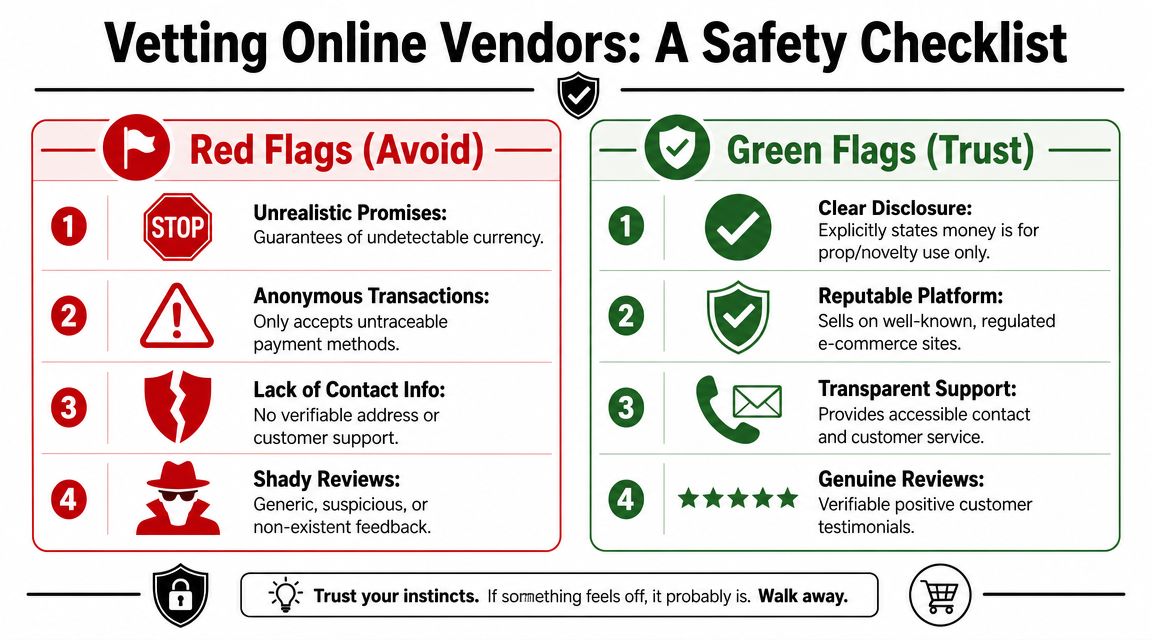
Red flags that point to criminal activity
Use this as a hard filter, not a soft suggestion.
- Private-channel sales first: The seller tells you to move to email, encrypted chat, or direct message before you can even understand the product.
- Passability language: Listings talk about “undetectable,” “usable,” “clean,” or “accepted everywhere.”
- No compliance detail: The site avoids plain statements that the bills are props or novelty items.
- Strange payment pressure: The seller pushes irreversible or obscure payment methods and wants speed.
- No verifiable business identity: There's no normal support path, no clear terms, and no sign this is a real retail operation.
Some sellers also rely on vague confidence tricks. They imply quality but refuse specifics. They promise safety but avoid written guarantees. They ask for trust while hiding the business itself.
Green flags that suggest a legitimate prop supplier
A lawful prop vendor acts like a business that expects scrutiny.
Here's what you want to see:
| Signal | What it usually means |
|---|---|
| Clear “prop” or “novelty” labeling | The seller understands lawful use |
| Standard ecommerce checkout | The seller isn't trying to vanish mid-transaction |
| Visible customer support | You can contact a real business |
| Product education | The vendor wants buyers to use items correctly |
| Public-facing FAQ | The seller has answered normal buyer concerns |
If you're comparing vendors, start with the seller's prop and novelty money FAQ. Then ask a simple question: does every other vendor provide this level of clarity, or are they asking you to infer legality from silence?
A legitimate prop supplier reduces ambiguity. An illicit seller depends on it.
That's the operational difference in one sentence.
The Smart Choice Making a Safe and Legal Decision
The search phrase “buy fake currency online” points to two completely different paths.
The first is counterfeit. That path involves deception, evasive sellers, hidden communication, payment risk, and criminal exposure. If the product is meant to pass as genuine, stop there. It isn't a gray area. It's a bad decision.
The second is legal prop currency. That path is for film crews, photographers, theater teams, educators, retail trainers, and novelty buyers who need a visual stand-in without crossing the line into fraud. The product should be clearly labeled, openly sold, and handled with discipline.
Don't confuse realism with legitimacy. Criminal rings chase survivability in the wild. Professional prop suppliers chase believability under controlled conditions. One is built for a scam. The other is built for a set.
If you need money that looks right on camera, buy compliant props from a transparent seller, document your purchase, and manage the items like any other production asset. If a vendor tries to pull you into secrecy, coded language, or off-platform negotiation, walk away.
That's the smart choice. It's also the only one that protects your project, your record, and your future.
If you need compliant novelty or prop-style banknote products for creative use, browse ubNotes and stick to clearly disclosed items meant for film, display, and other lawful scenarios. Buy like a professional. Keep records, verify markings, and never blur the line between a prop and a crime.
Produced via Outrank tool